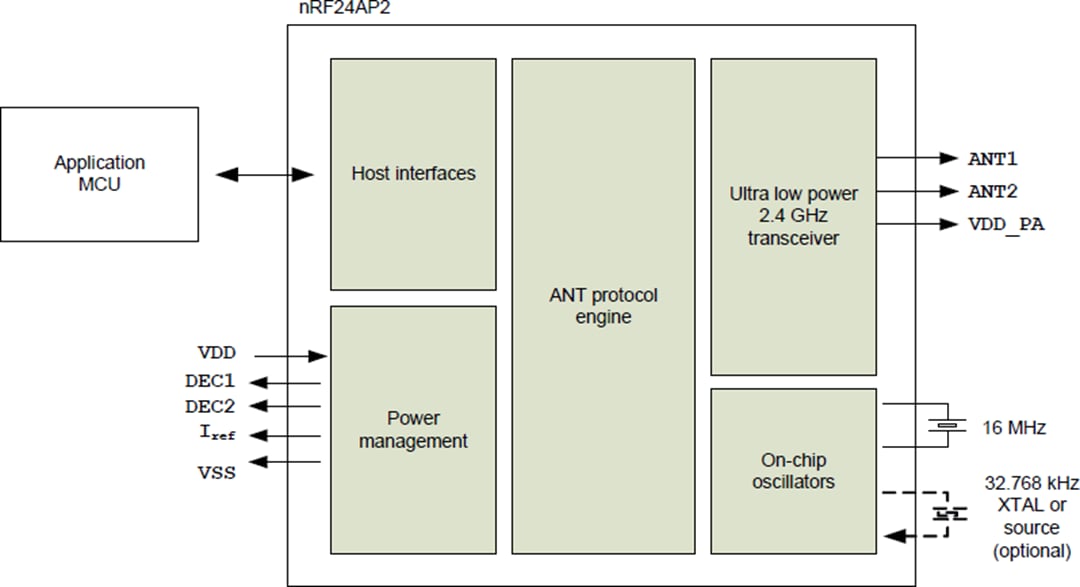
Nordic Semiconductor nRF24AP2 Single-Chip ANT™ Ultra-Low Power Wireless Network Solution is a low-cost, high-performance 2.4GHz ISM single chip transceiver solution for Ultra Low Power (ULP) networks. Th nRF24AP2 integrates the power efficient ANT protocol stack, industry-leading 2.4GHz RF technology, and a critical low-power oscillator and timing features. The second-generation single-chip ANT solution acts as a bridge between ANT networks and computers, Mac books, and the Internet. The nRF24AP2-USB supports up to eight ANT channels and is ideal for hubs. This solution provides worldwide 2.4GHz ISM band operation. Typical applications include sports, wellness, home health monitoring, home/industrial monitoring, and environmental sensor networks.
Features
Ultra low power 2.4GHz transceiver
World wide 4GHz ISM band operation
Based on nRF24L01+ transceiver
GFSK modulation
1Mbps on-air data rate
1MHz frequency resolution
78 RF channels
-85dBm sensitivity
Up to 0 dBm output power
ANT protocol stack
Full implementation of the physical, data link, network- and transport OSI layers
Packet-based communication – 8 byte payload per packet
Optimized for ultra-low power operation
ANT channels
Logic communication channel between ANT nodes
nRF24AP2-1CH supports 1 channel, ideal for sensors
nRF24AP2-8CH support up to 8 channels, ideal for hubs
Built-in timing and power management
Built-in interference handling
Configurable channel period from 5.2ms to 2s
Broadcast, acknowledged and burst communication modes
Burst data rate up to 20kbps
Device search and pairing
Wild-card searches
Proximity searches
Specific searches
Automatic link establishment if correct device is found
Automatic re-link attempt if link is lost
Configurable search timeout
Network topologies
Point-to- point and star networks using independent ANT channels
Shared networks: Polled data collection (N:1) by using ANT shared channel option
Network management / ANT+
Supports public and private (managed) networks
Support for ANT+ system implementations enabling multi-vendor interoperability
ANT core stack enhancements
Background scanning channel
Continuous scanning mode
High density node support
Improved channel search
Channel ID management
Improved transmission power control on a per channel basis